
Why You're Staring at Your Phone Instead of Your Partner (And How to Stop)
Feb 19, 2026
You know the feeling.
You're sitting on the same couch. Maybe even in the same bed. Close enough to touch. But you might as well be on different planets.
You're scrolling through Instagram — not because you care about the content. You couldn't tell me what you just saw if I asked. You're scrolling because it's a digital bunker. It's a place where nothing can hurt you. Where nobody's tone can shift. Where you don't have to brace for the sigh, the eye-roll, or the question that's really an accusation wearing a question mark's clothing.
Your phone isn't entertainment right now. It's a shield.
And somewhere in the back of your mind, there's a quiet voice saying: We used to talk for hours. We used to laugh in this room. When did this couch become a demilitarized zone?
If you're reading this and your chest just tightened — stay with me.
You aren't toxic. You aren't broken. You aren't "bad at relationships."
You're exhausted. And your body has found the cheapest, fastest way to protect you from more pain: avoidance wrapped in a glowing screen.
But here's the thing about bunkers — they keep the danger out. They also keep the love out.
[IMAGE: Person sitting alone, phone glow on face, dim room — contemplative mood]
The House That Stopped Breathing
Let me tell you about Sarah and Marcus.
They've been together for eleven years. Two kids. Good jobs. From the outside, it looks like a life that's working. Nice house. Family vacations. The kind of couple people describe as "solid."
But inside that house, something has gone quiet in a way that feels louder than any argument ever did.
It started slowly — the way these things always do. A few years of unresolved tensions. Arguments that never quite got finished, just abandoned mid-sentence and buried under the next day's routine. Feelings that got swallowed instead of spoken because speaking them felt too dangerous. Not dangerous like violence — dangerous like if I say what I actually feel, this whole thing might fall apart, and I can't afford for this to fall apart.
So they stopped. Both of them. Not all at once. But gradually, the house developed a vibe.
Marcus noticed it first, though he wouldn't have used that word. He just noticed that when he pulled into the driveway, his hands would grip the steering wheel a little tighter. He'd sit in the car for an extra five, ten minutes. Not thinking about anything in particular. Just... not going in yet. His body was bracing for something his mind couldn't name.
Sarah noticed it differently. She noticed that when Marcus walked through the door, her whole system would scan him in a fraction of a second. What mood is he in? Is he distant tonight? Is this going to be one of the quiet nights or one of the hard nights? She'd feel her shoulders creep up. Her voice would get a little higher, a little more controlled. Cheerful — but the kind of cheerful that's working really hard.
By 8:30 PM, they'd be on the couch. Together. Alone. Marcus on his phone. Sarah on hers. The TV playing something neither of them chose. The kids asleep. The house still.
And that stillness — which should feel peaceful — felt like holding your breath underwater and not knowing when you're allowed to come up.
That house had stopped breathing. Not the people in it — the relationship itself. The invisible thing between them that used to pulse with warmth and laughter and "tell me about your day" had flatlined into something gray and careful and small.
And the worst part? Both of them thought it was their fault. Marcus thought he was emotionally unavailable. Sarah thought she was too needy. They had each internalized a story about their own deficiency — I'm the problem — that kept them locked in separate bunkers, three feet apart, every single night.
 ]
]
What's Actually Happening in That Room
Sarah and Marcus don't have a communication problem. They don't have a love problem. They don't even have a compatibility problem.
They have a nervous system problem. And until someone explains that to them, they will keep trying to solve a biological crisis with psychological tools — and wondering why nothing changes.
Here's what I need you to understand, because this is the piece that changes everything:
Your body is scanning the room for safety every single second of every single day. You don't choose to do this. You can't turn it off. It's happening right now, as you read these words.
This process is called neuroception. It's your nervous system's below-conscious threat-detection radar. It doesn't use logic. It doesn't use language. It reads the room through cues so subtle you'll never consciously notice them: micro-shifts in your partner's facial muscles, changes in vocal tone, posture adjustments, breathing patterns, even the rhythm of footsteps coming down the hallway.
Based on that scan, your nervous system makes a decision — in milliseconds, without consulting you — about whether the environment is safe, dangerous, or life-threatening.
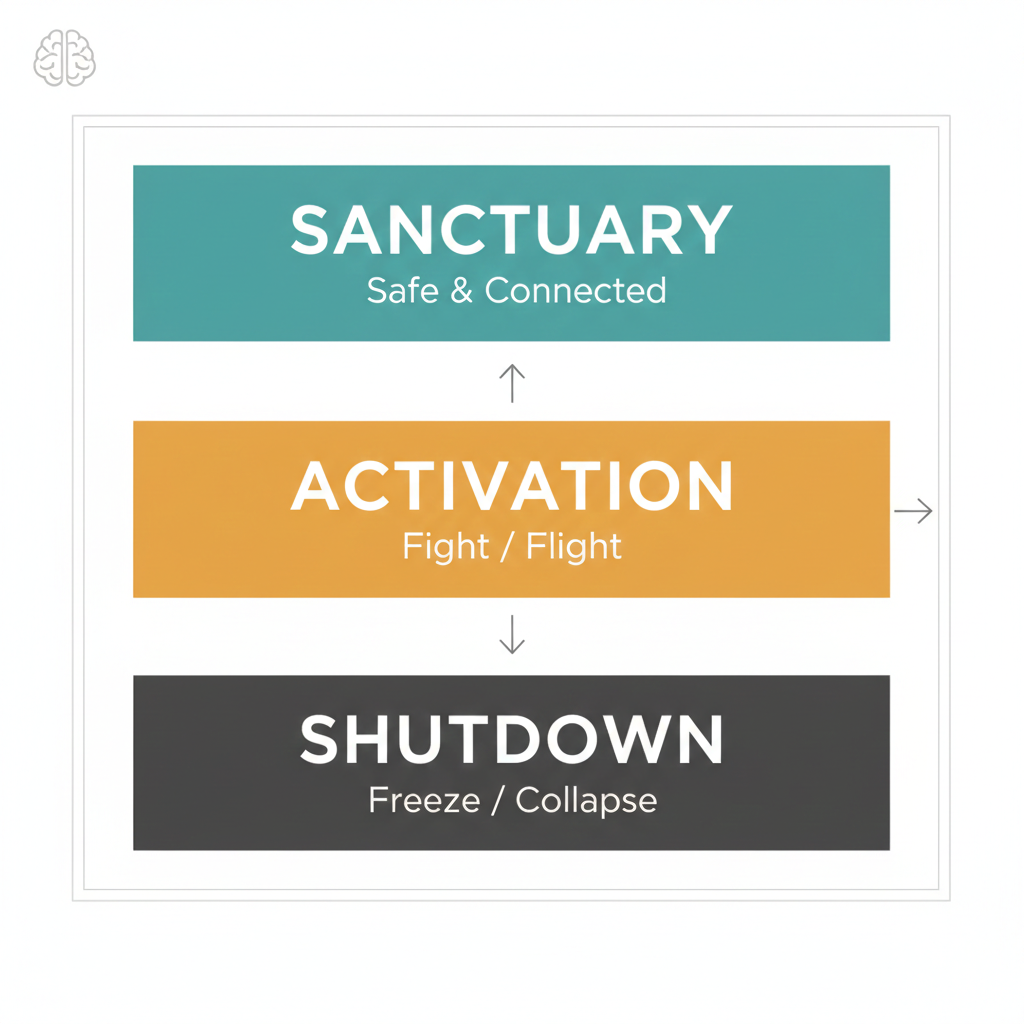
If it reads safety: you relax. Your breathing deepens. Your face softens. You can make eye contact. You can laugh. You can be vulnerable. You can be you.
If it reads danger: you activate. You go into Fight (the sharp tone, the criticism, the need to control) or Flight (the withdrawal, the "I need space," the retreat to another room or another screen).
If it reads life-threat: you shut down. This is the Dorsal Vagal response. You go numb. You lose your words. You're physically present but neurologically gone. This is the flatline on the couch. The scrolling. The "I'm fine" that means absolutely nothing.
And here's the part that locks it all into a loop:
Your partner's neuroception is scanning you at the same time.
Whatever state your nervous system is in, their system reads it like a broadcast signal. If you're shut down, their system registers: they're gone. I'm alone. This is dangerous. And their system either matches your shutdown — two people in two separate bunkers — or it escalates into pursuit mode, chasing connection with questions, complaints, or intensity. Not because they're "nagging." Because their nervous system is desperate for a safety signal that isn't coming.
Bunker Mode and Seeker Mode: The Two Survival Scripts
In the Bio-Sanctuary Protocol™, I've identified two primary ways this plays out in relationships — and once you see them, you'll recognize them in your own living room immediately.
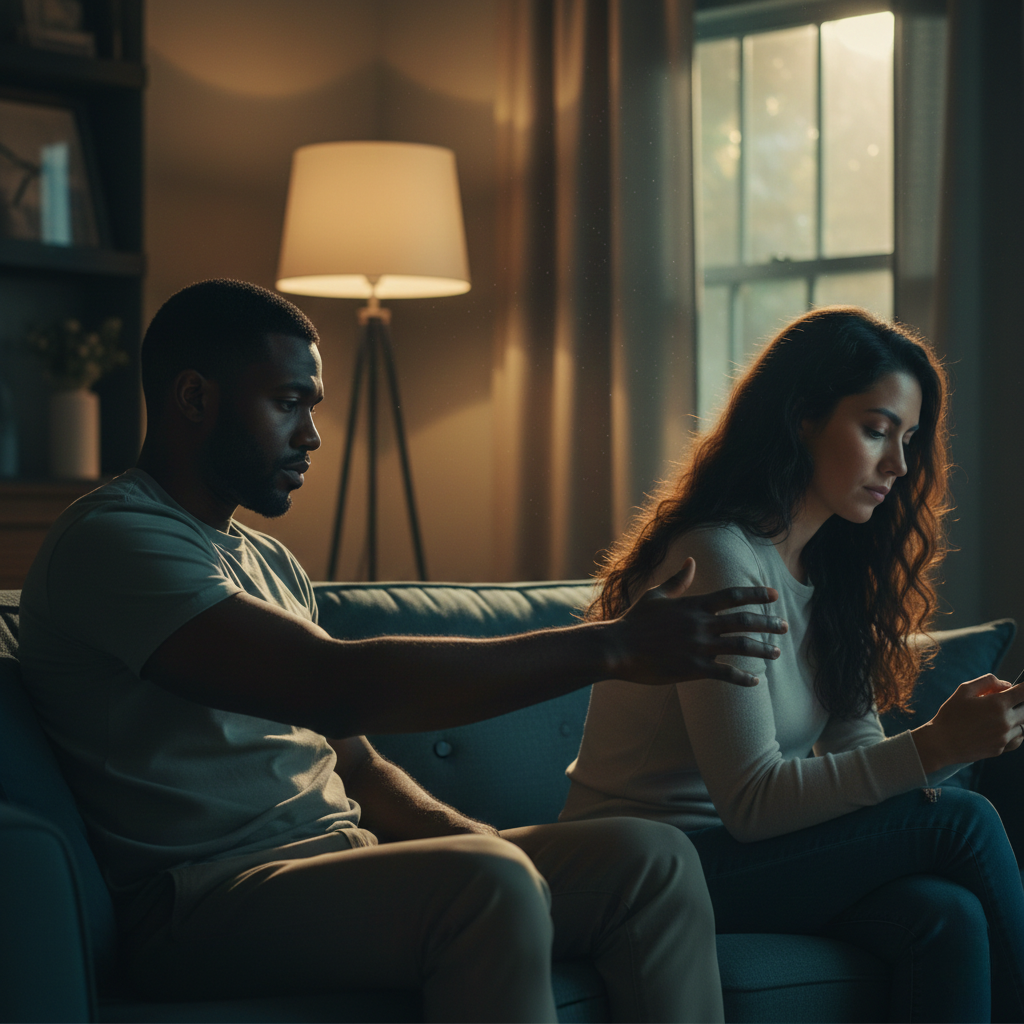
Bunker Mode is the shutdown response. It's Marcus on the couch. Phone up. Eyes glazed. Somewhere between numb and exhausted. From the outside, it looks like he doesn't care. From the inside, his nervous system has pulled the emergency brake because the emotional voltage of the relationship has exceeded what his body can process. He hasn't chosen to check out. His brain literally disconnected the wires to his speech and emotion centers to protect him from overload.
Bunker Mode sounds like:
- "I'm fine." (Said flatly, meaning nothing.)
- Silence that stretches for hours or days.
- Being in the room but not in the room.
- Answering in one-word responses that close every door.
Seeker Mode is the activation response. It's Sarah scanning Marcus's face the moment he walks in. It's the questions that come faster when he goes quiet. It's the need to resolve, to connect, to get something — any signal at all — that tells her she's not alone in this. From the outside, it looks like she's "too much." From the inside, her nervous system is screaming that if this person goes silent, she'll be abandoned. And abandonment, to her biology, registers as a survival threat.
Seeker Mode sounds like:
- "Can we just talk about this?"
- "What are you thinking?"
- Following them from room to room.
- The inability to let a conflict rest unresolved, even at midnight.
Neither of these is a character flaw. Both of them are survival scripts — written by the nervous system, performed by the body, without either person's conscious permission.
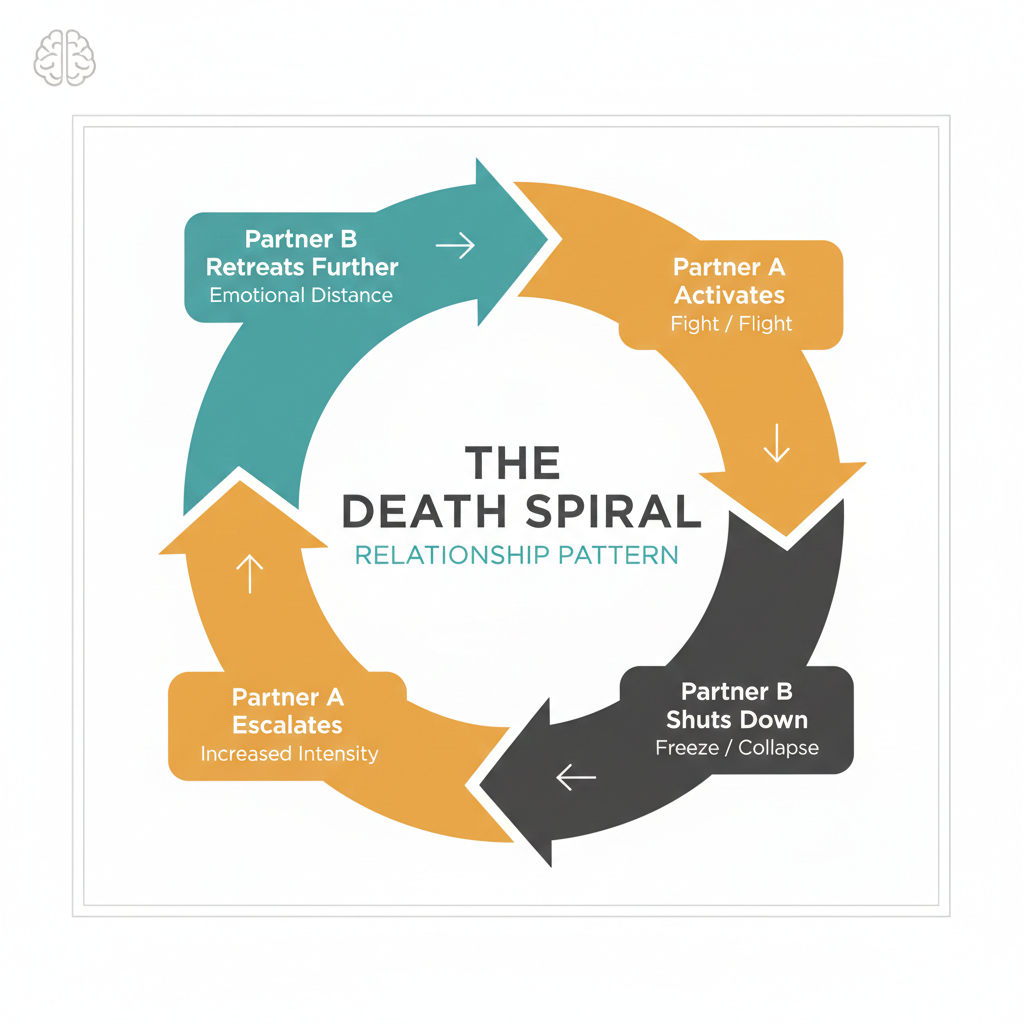
And here's the cruel geometry of it: Seeker Mode and Bunker Mode almost always find each other. The Seeker's intensity is the exact voltage that drives the Bunker deeper. The Bunker's silence is the exact signal that sends the Seeker into overdrive. They trigger each other perfectly. Not because they're incompatible — but because their survival systems are locked in a loop that neither of them built and neither of them knows how to exit.
This is what I call the Death Spiral. And it will run on autopilot until someone changes the signal.
The Part That Might Make You Cry
Here's what breaks my heart about Sarah and Marcus — and about every couple stuck in this pattern.
They both still love each other. That's the part that gets lost. Underneath the silence and the scanning and the scrolling and the careful distance, there are two people who chose each other. Who built something together. Who, if you asked them separately in a quiet moment, would both say some version of: I don't want this. I want it to be like it was. I just don't know how to get back there.
The love isn't gone. It's buried under layers of survival. The nervous system has built so many walls to protect against pain that the love can't get through anymore. Not because it doesn't exist — but because the body doesn't feel safe enough to let it in.
And that's the tragedy of the digital bunker. Every night on the couch, scrolling in silence, Sarah and Marcus are both aching for the same thing: connection. Safety. The feeling of being seen by the person who's supposed to know them best. But their nervous systems have concluded that reaching for that connection is too risky. So they stay in their bunkers. Parallel. Close. Completely alone.
The phone isn't the problem. The phone is the symptom. The problem is that the space between them doesn't feel safe. And until that changes, no amount of "communication tips" or "quality time" will penetrate the armor.

The 6-Second Interruption
So what changes it?
Here's what I've learned from years of working with couples and individuals in the Bio-Sanctuary Protocol™: you cannot think your way back to connection. You cannot talk your way back to connection — at least not while both nervous systems are in survival mode. You cannot willpower your way past walls that your biology built for your protection.
But you can signal your way back. Through the body. In six seconds.
I call it the 6-Second Anchor. And it's the entry point to everything I teach in the Inner Sanctuary™ Method.
Here's what you do.
At some point tonight — not during a fight, not during a "moment," just during the ordinary quiet — put your phone down. Walk to your partner. Don't say anything. Make eye contact. And hold a hug.
Not a side-hug. Not the two-second pat you do when you're leaving for work. A full, grounded, chest-to-chest hold.
And stay there for six seconds.

Why six seconds? Because that's the minimum threshold for your brain to begin releasing Oxytocin — the neurochemical of bonding, trust, and safety. Anything less and your brain registers it as a social gesture — nice, but neurologically insignificant. At six seconds, something shifts. The Oxytocin signal reaches a level where it actively begins breaking down Cortisol — the stress hormone that's been stacking in both of your bodies.
In six seconds, you are manually overriding the threat signal. You are telling your partner's nervous system — in the only language it truly trusts, which is physical — that you are not a threat. That you are here. That the armor is down. That this space, right here, between your two chests, is safe.
That's a Biological Handshake. And it is more powerful than any conversation you could have right now.
Will it feel awkward the first time? Probably. Especially if you've been in the bunker for a while. Your body might resist it. Your partner might stiffen. That's okay. That's the survival suit doing what it does — bracing for impact because it's forgotten what safety feels like.
Do it anyway. Not because it will fix everything in one night. But because it will interrupt the pattern. For six seconds, the loop stops. The scrolling stops. The scanning stops. Two nervous systems, for just a moment, remember what it feels like to be home.
And that moment — that six-second crack in the armor — is where the healing begins.
If You're Single, This Is for You Too

I want to speak directly to those of you who read Sarah and Marcus's story and thought: That's why I'm alone. That's why I left. That's what I'm terrified of walking into again.
The 6-Second Anchor works for you too — with yourself.
Before you walk into a date, a family dinner, a social situation that makes your nervous system want to armor up — place both hands on your own chest. Press in. Feel the warmth. Feel the weight. And breathe for six seconds. Slow inhale. Long exhale.
You are giving yourself the safety signal that nobody taught you to give yourself. You are being your own Biological Handshake. You are telling your own nervous system: I've got you. You don't have to scan the room. I am the sanctuary.
Because here's what I teach every client who walks through my door: you take your nervous system with you into every relationship you enter. If your system is calibrated for danger — if Seeker Mode or Bunker Mode has been running so long it feels like personality — you will recreate the pattern no matter how good the next person is.
The pattern isn't about them. The pattern is in your biology. And when you learn to anchor yourself in safety first, you stop attracting what's familiar and start attracting what's actually good for you.
What Happens After the Six Seconds
The 6-Second Anchor is a beginning. It's a crack in the wall. But if the patterns in your home — or in your dating life — are deep, if they've been running for years, if your nervous system has been in survival mode for so long that you've forgotten what "regulated" even feels like — you're going to need more than a single tool.
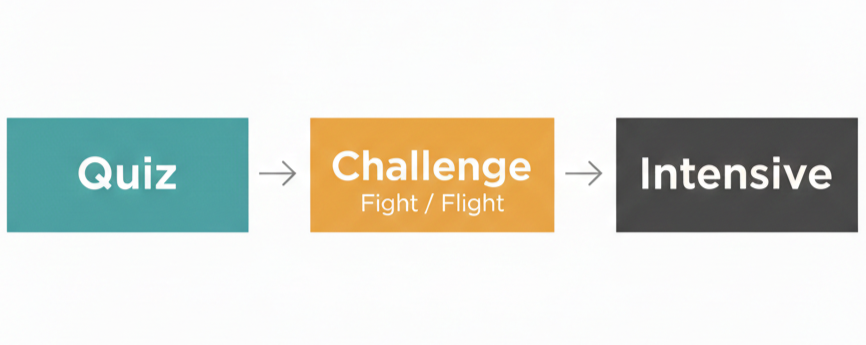
That's why I created two pathways for the people who are ready to go deeper.
The 5-Day Biological Consent Challenge
This is for you if you're curious. If something in this post made you sit up. If you want to understand your nervous system pattern and start experimenting with somatic tools in a supported container.
Over five days, I walk you through your unique Relational Nervous System profile and give you daily micro-practices designed specifically for your archetype. It's gentle. It's eye-opening. And for most people, it's the first time anyone has explained why their body does what it does in relationships — without shaming them for it.
This isn't homework. It's a homecoming.
Join the free 5-Day Biological Consent Challenge → mind-fusion.com/tiny-challenge
The "Stop the Death Spiral" Intensive
This is for you if you're past curious. If you're in it right now — the loop, the silence, the couch, the scrolling, the bracing. If you've read this entire post with a knot in your stomach because it's describing your living room with uncomfortable accuracy.
The Intensive is a deep, somatic reset using the Bio-Sanctuary Protocol™ and Hypno-Breath Fusion™. We don't just talk about the pattern. We go into the body and dismantle it at the root. We identify the exact moment your nervous system leaves the Sanctuary and enters Survival Mode — and we build a biological anchor that brings you back in seconds, not days.
I have 5 seats open. This is for the person who's done reading about the problem and ready to feel the shift in their own body.
Apply for the "Stop the Death Spiral" Intensive → mind-fusion.com/intensive
The Screen Can Wait. Your Nervous System Can't.
Tonight, at some point, you're going to be on that couch again. The TV will be on. The phones will be out. The house will be quiet. And you'll have a choice.
You can stay in the bunker. You can keep scrolling. You can keep the peace by keeping the distance. Nobody will blame you. It's what your nervous system has been trained to do.
Or you can put the phone down. Look at the person next to you — the person you chose, the person who chose you, the person who is probably just as exhausted and just as scared and just as hungry for a signal that this is still worth fighting for — and you can offer six seconds of something real.
Not a fix. Not a conversation. Not a grand gesture.
Just your chest against theirs. Your breath slowing down. Your body saying what your words have forgotten how to say: I'm still here. I still choose this. And I'm not going anywhere.
Six seconds.
That's how the Sanctuary starts.

Your phone will still be there when you're done.
Your relationship might not be.
Choose wisely tonight.
Start with the 5-Day Biological Consent Challenge → mind-fusion.com/tiny-challenge
Erica | Mind Fusion Transformations | Relationship Nervous System Coaching
"You aren't broken. Your nervous system is just doing its job. Let's give it a new one: connection."
SOCIAL LINKS: @mindfusioncoach | @ericadc75 | mind-fusion.com
Stay connected with news and updates!
Join our mailing list to receive the latest news and updates from our team in our weekly newsletter.
Don't worry, your information will not be shared.
We hate SPAM. We will never sell your information, for any reason.
Meet the Author