
Relational Shadow Work: How to Stop Projecting and Heal Your Relationships
Apr 18, 2026
Relational shadow work is the practice of examining what we unconsciously assign to the people closest to us — and tracing it back to where it actually belongs: inside ourselves. It is also, without question, some of the most uncomfortable and most freeing work a high-achieving adult can do for their nervous system and their closest relationships.
There's a version of stress that feels completely justified. Someone in your life is being irresponsible, or lazy, or needy, or checked out, and your frustration makes sense. It has a logical explanation. A clear target.
This is the most seductive form of nervous system dysregulation there is — because it feels like clarity. It feels like being right.
What it actually is? Projection.
And understanding it — not intellectually, but in your body — might be the most important thing you do for your relationships this year.
What Is the Shadow, Really?
Carl Jung described the shadow as the sum of everything we cannot admit to ourselves. But in the world of nervous system work, the shadow has a more specific definition:
The shadow is the collection of traits and emotional states that your early environment marked as dangerous to have.
Not dangerous in the objective sense. Dangerous in the relational sense — traits that, as a child, cost you love, approval, safety, or belonging when you expressed them.
The child who was shamed for being messy learns that imperfection is dangerous. The child who was criticized for being "too sensitive" learns that emotional need is dangerous. The child who had to take care of a parent's feelings learns that their own needs are dangerous.
These are nervous system programs. They're not beliefs you chose — they're physiological patterns encoded below the level of conscious awareness. And they run on autopilot for the rest of your life, quietly shaping the way you see the people around you.
The shadow isn't created by bad parenting or dramatic trauma alone. It's created by any environment — well-meaning or not — where certain parts of you repeatedly received the message: not this. Not here. Not safe.
The Four Projections of the Archetypes
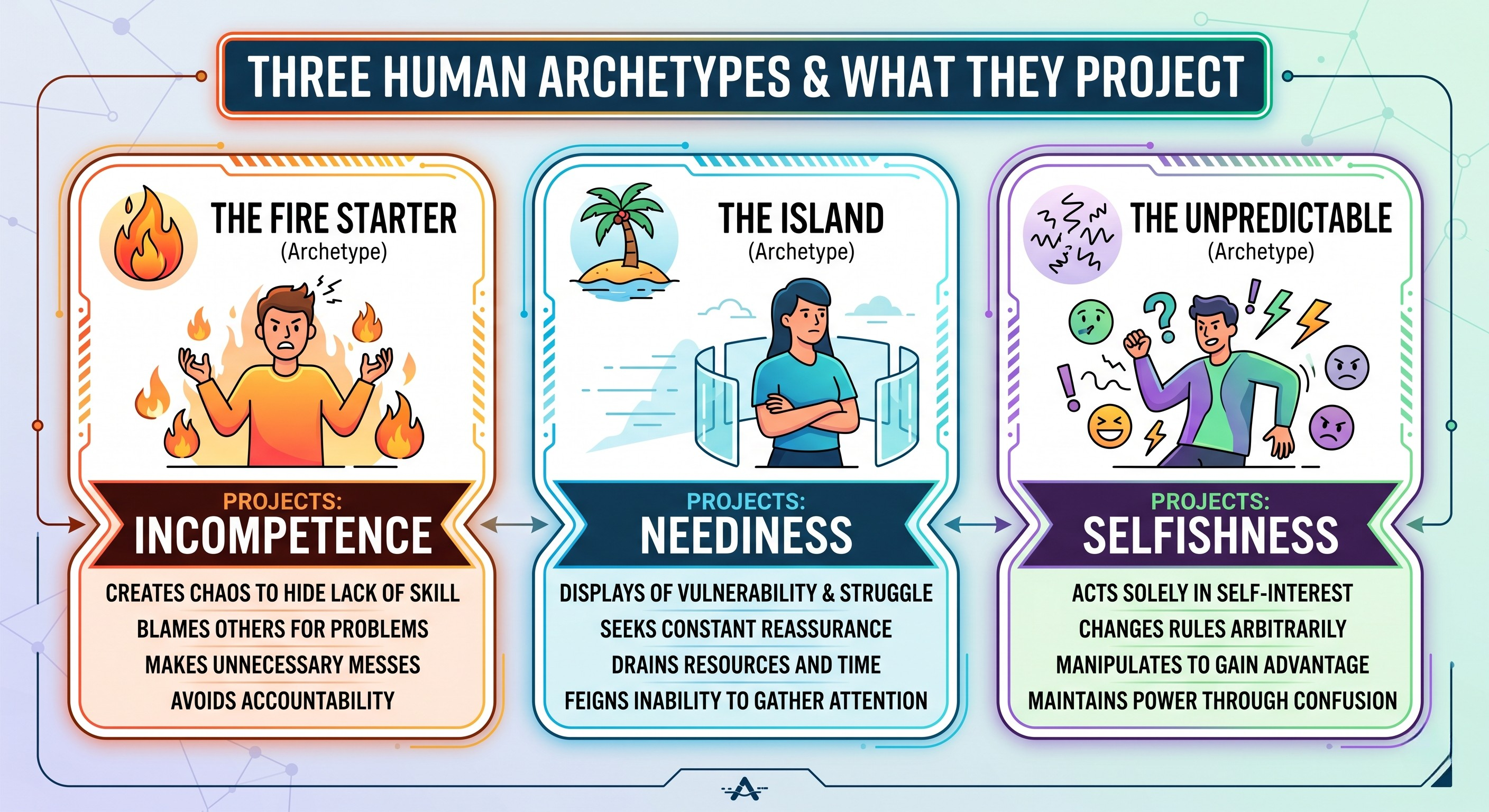
In the nervous system framework I use with clients, we work with three primary archetypes — the Fire Starter, the Island, and the Unpredictable. Each one has a signature shadow projection.
The Fire Starter projects incompetence. This is the high-achiever who cannot tolerate slowness, imperfection, or someone else's different approach to a task. Underneath the frustration is a nervous system that was trained to associate being in control with being safe. They cannot rest in their own helplessness — so they see it everywhere else and call it a problem.
The Island projects neediness. This is the self-sufficient person who keeps their feelings behind glass — who manages and contains and stays reliable. They needed to disconnect from their own need for closeness to survive an environment that couldn't meet it. So when someone in their life needs reassurance, closeness, or emotional availability, the Island reads it as suffocating. They're not judging the need — they're defending against it. Because somewhere in their system, needing is still coded as dangerous.
The Unpredictable projects selfishness. This is the caretaker, the giver, the person who reads every room and adjusts to make everyone else comfortable. They've survived by making themselves useful, undemanding, endlessly accommodating. And so when someone in their life has a boundary, takes up space, or prioritizes themselves without apology, the Unpredictable feels a flash of contempt. Not because they're petty — but because they're grieving the self they were never allowed to be.
Here's what all three of these projections have in common:
They are not about the other person. They are survival strategies that outlived their usefulness.
The "I Own This" Somatic Reset
Understanding your projection pattern is important. But the nervous system doesn't change through understanding alone. It changes through experience. Through new somatic data. Through moments where you interrupt the old response and do something different.
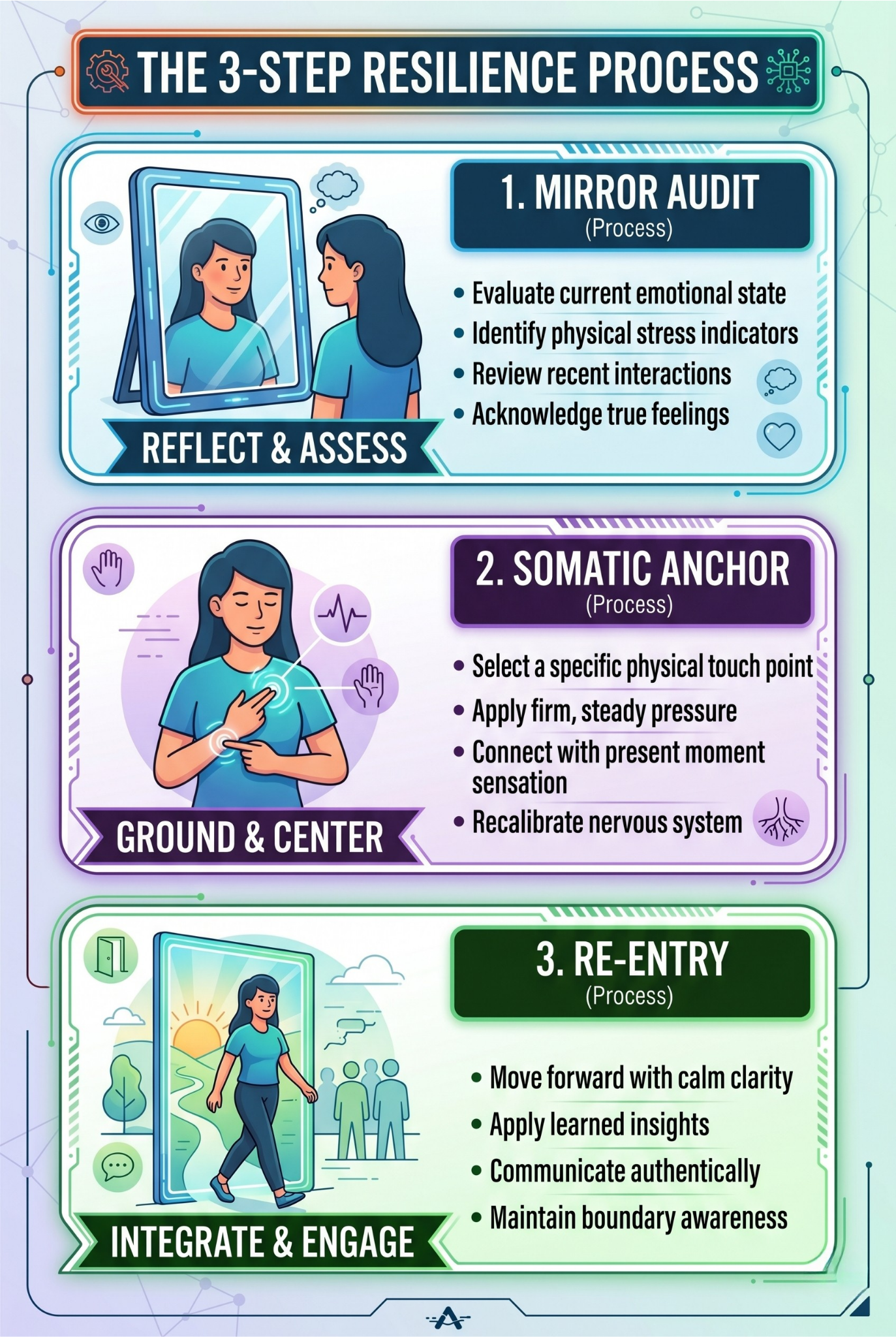
Here is a three-part somatic tool for working with projection in real time:
Step One: The Mirror Audit
Before you address the "problem" in your household or your relationship, sit with these three questions:
"What trait in them am I calling unacceptable — and when did I decide that trait was dangerous in me?"
"If I remove their behavior from the equation, what is this feeling in my body right now? Does it feel like today, or does it feel like yesterday?"
"How does judging them protect me from feeling my own vulnerability right now?"
These questions work because they redirect attention from the external narrative to the internal physiological state — which is where the actual data lives.
Step Two: The Somatic Anchor
Once you've identified that the heat is yours, place one hand on your heart and one on your belly. Breathe into the activation — not to eliminate it, but to stay present with it. Hold the posture until the urgency to speak, to fix, to correct, drops by 20%.
That 20% is enough. You're not trying to become a different person. You're creating just enough of a pause for your prefrontal cortex to come back online.
Step Three: The Re-Entry
Walk back in and speak from the feeling, not the judgment.
Not: "You're so irresponsible." But: "I'm feeling really overwhelmed and I need some help right now."
Not: "You never listen." But: "I'm feeling disconnected and I need to feel heard."
This shift — from judgment to feeling — is the shift from projection to connection. And it will change the quality of your closest relationships over time in ways that are not subtle.
The Shadow Is Not the Enemy
Shadow work has a reputation for being heavy. For being about all the dark, unwanted parts of us. And yes — it requires courage to look.

But here's what I've seen, again and again, in the people who do this work:
The shadow is not the enemy. The shadow is the exile.
It's the part of you that got sent away — the rest you weren't allowed to have, the need you were told was too much, the slowness that was shamed, the tears that were inconvenient — and it has been trying to get your attention through your relationships ever since.
When you stop attacking it in others and start giving it space inside yourself, something shifts. Not just in you — in the people around you. Because the nervous system is contagious. Your regulation becomes an invitation.
That's what somatic shadow work makes possible.
Ready to stop projecting and start owning?
Take the Relational Nervous System Quiz to identify your archetype and start the mirror work: mind-fusion.com/relationship-nervous-system-quiz
Want more somatic insights for high-performance leaders? Subscribe to my LinkedIn Newsletter, The Regulated Leader, for weekly deep dives.
Stay connected with news and updates!
Join our mailing list to receive the latest news and updates from our team in our weekly newsletter.
Don't worry, your information will not be shared.
We hate SPAM. We will never sell your information, for any reason.
Meet the Author